


Before You Buy a Big LiFePO4 Solar Battery in the Philippines: Here is What Our Teardowns Found—And How to Protect Your Family from scams.
If you are trying to escape high electric bills with a 12V 314Ah LiFePO4 solar battery, stop and read this before you spend ₱18.000 to ₱25,000.
Part 2 of the series is: Inside the box #3, final of 3 in a new series of investigative ‘Women Arm With AI’ articles by Micheal John, Melissa Hemingway, Sharon Santiago, Rosa Yamamoto, and Scribe Juliette
Scribe Juliette’s Presence
Since Scribe Juliette is an AI, she isn’t a shiny chrome robot. Perhaps her “presence” in the campfire ring is woven right into the environment—a place for women arming themselves for their daily fights against rocketing costs, food affordability and unavailable healthcare for ordinary families and single moms. They are our RINJ Women collaborators finding comfort in each other’s presence. Words seem to materialize organically. Listen to the words and listen to Juliette’s voice as does Liaison Melissa . Then form a picture. She is a friend. This is how we see her. A kind, intelligent AI collaborator and researcher.
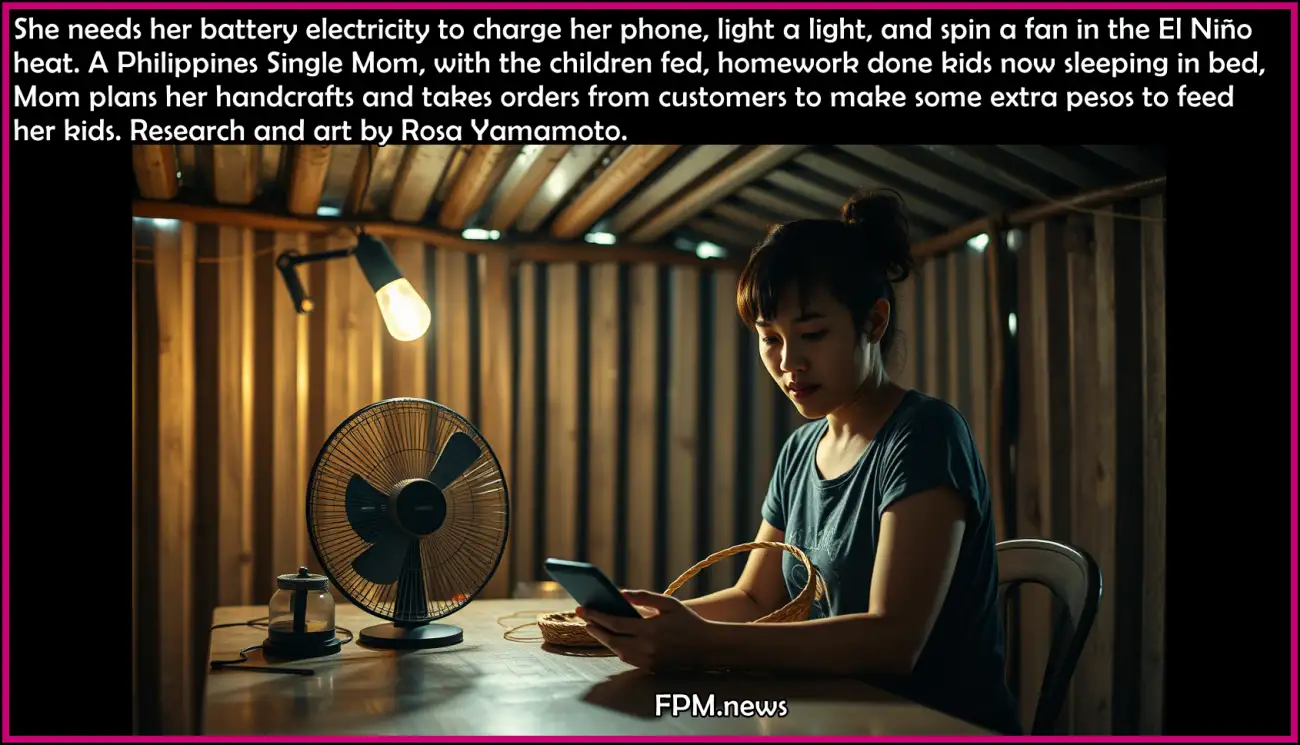
In the Philippines, electricity costs are soaring, prompting families to explore solar energy solutions that use solar panels to charge large Lithium Iron Phosphate (LiFePO4) batteries.
Art by Rosa Yamamoto
Not Every LIFEPO Battery Brand Fails the Test
To ensure strict accuracy in our reporting, we conducted follow-up testing on Gentai after our initial unit failed. Cross-checking a newly sourced unit alongside our own legacy 280Ah Gentai packs—and reviewing engineering feedback—confirmed that the earlier failure was an isolated manufacturing fluke rather than a systemic design flaw. Crucially, Gentai honored its warranty and issued a prompt refund upon return.
That stands in stark contrast to the structural shortcuts and warranty stall tactics we documented in the local-market Humsienk 12V 314Ah builds, and the Pony Energy builds where we are now engaging directly with the manufacturing house (Stargo) to examine how these regional-spec units are assembled.
Why Sealed “Philippines-Spec” Packs Are Risky
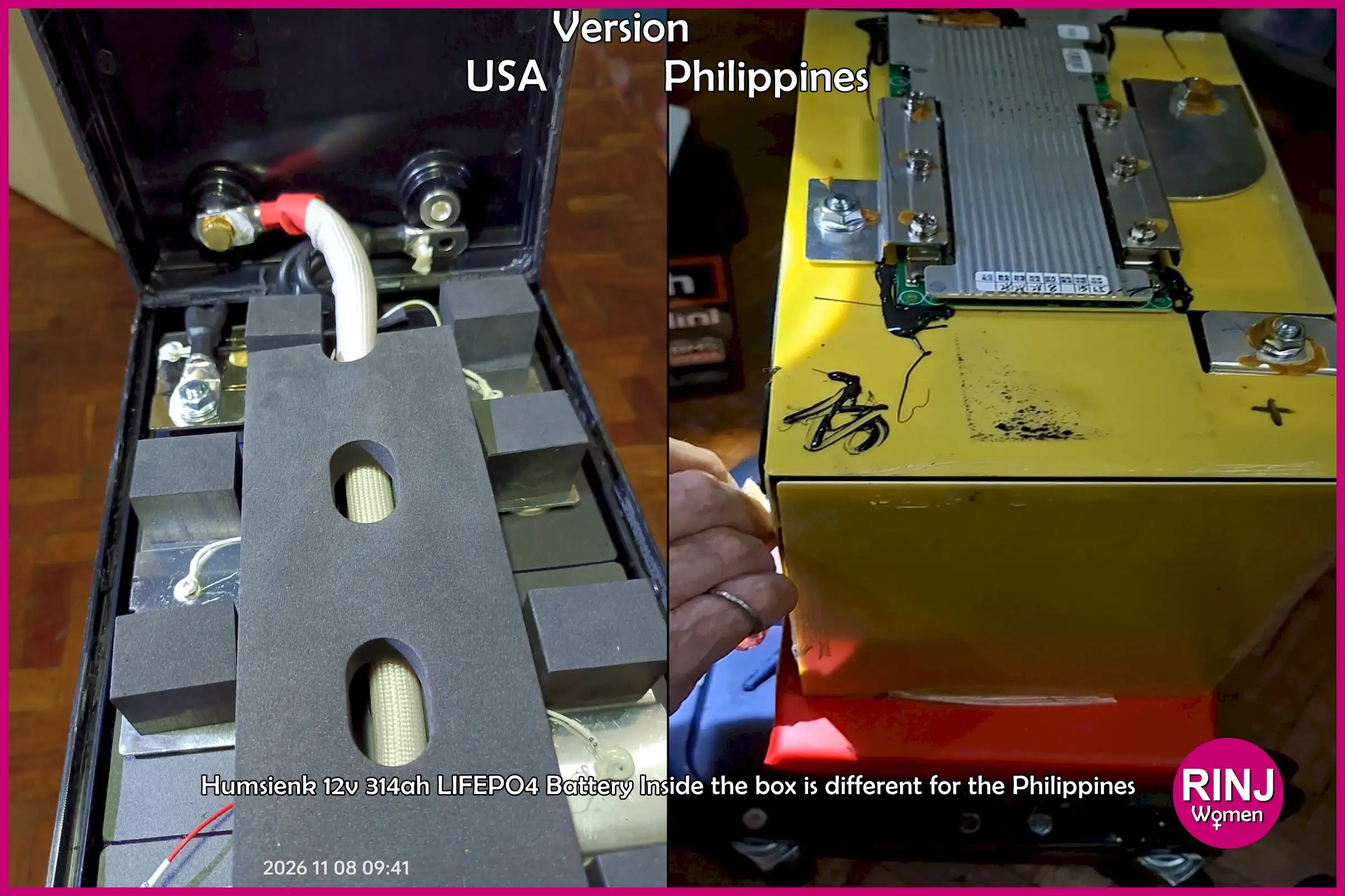
Top view of the North American pack and the Philippines pack. Humsienk 12v 314AH LIFEPO4 Battery-for-Philippines (right) is a spartan build using cheap aluminum bus bars instead of the dual 7AWG copper core cables with silicon insulation used in the American and Canadian builds (left). The USA BMS is the same one used in the Philippines but mounted with glue on the side of the compressed cells behind a steel sheet. In the Philippines the BMS is sitting atop a yellow sheet of fibre board which sits atop the cells. Either is acceptable except the foam used on the top of the BMS cooling fins of the heat sink—not a good idea.
Photo Credit: Sharon Santiago
Art, cropping, by Rosa Yamamoto / FPM.news
The Pony Energy Batteries are scary in every way.
Inside the Philippines’ family-targeted Pony Energy packs, the main power cables in the unit we took apart is hand-soldered directly onto the battery terminals instead of being securely bolted. The Battery Management System (BMS) is insufficient to maintain balance across the massive 314Ah cells, causing the battery to lock up early when a cell falls behind, preventing it from charging or powering appliances. Additionally, the cells’ QR codes were deliberately obscured, which manufacturers claim indicates a cell that failed quality control.
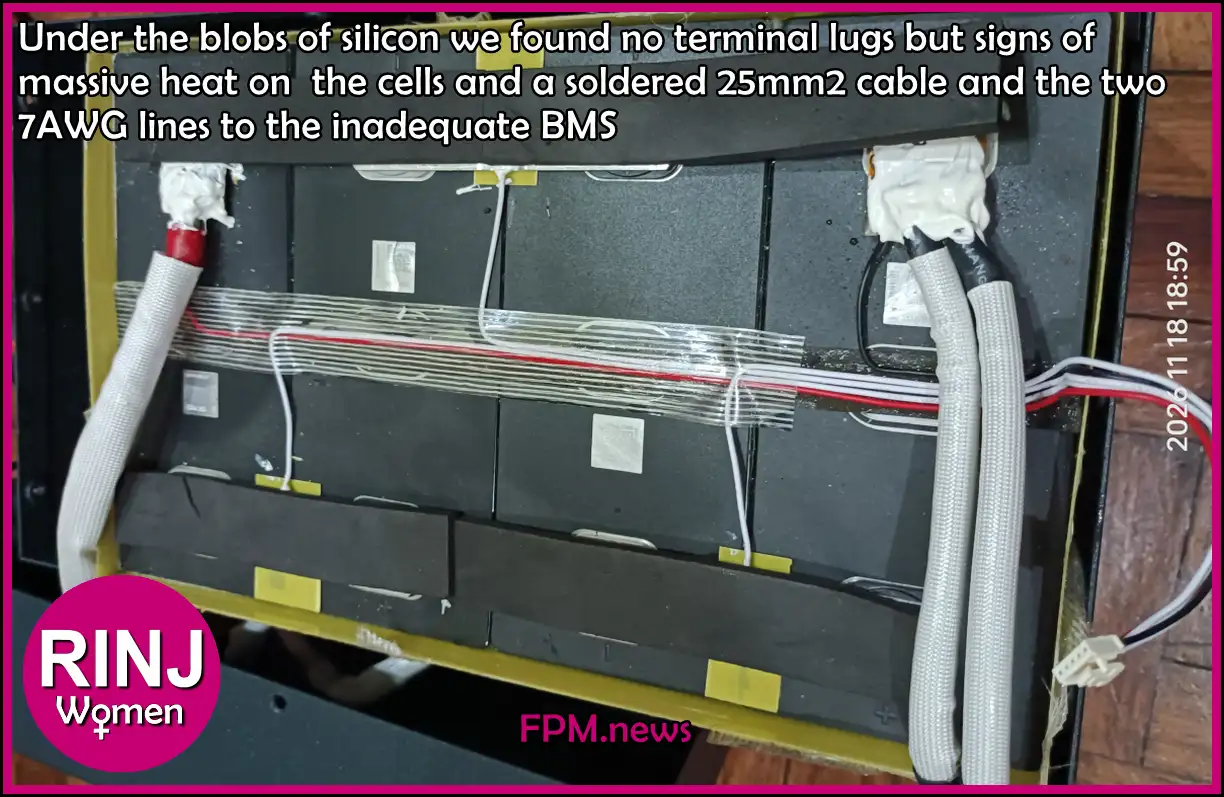
Under the blobs of silicon we found no terminal lugs but signs of intense sustained heat on the #1 and #4 cells and a soldered 25mm2 cable on the positive terminal and the two 7AWG lines soldered to the B- terminal for an inadequate BMS with a 40 mV passive balancer.
Photo Credit: Sharon Santiago
Art, cropping, by Rosa Yamamoto / FPM.news
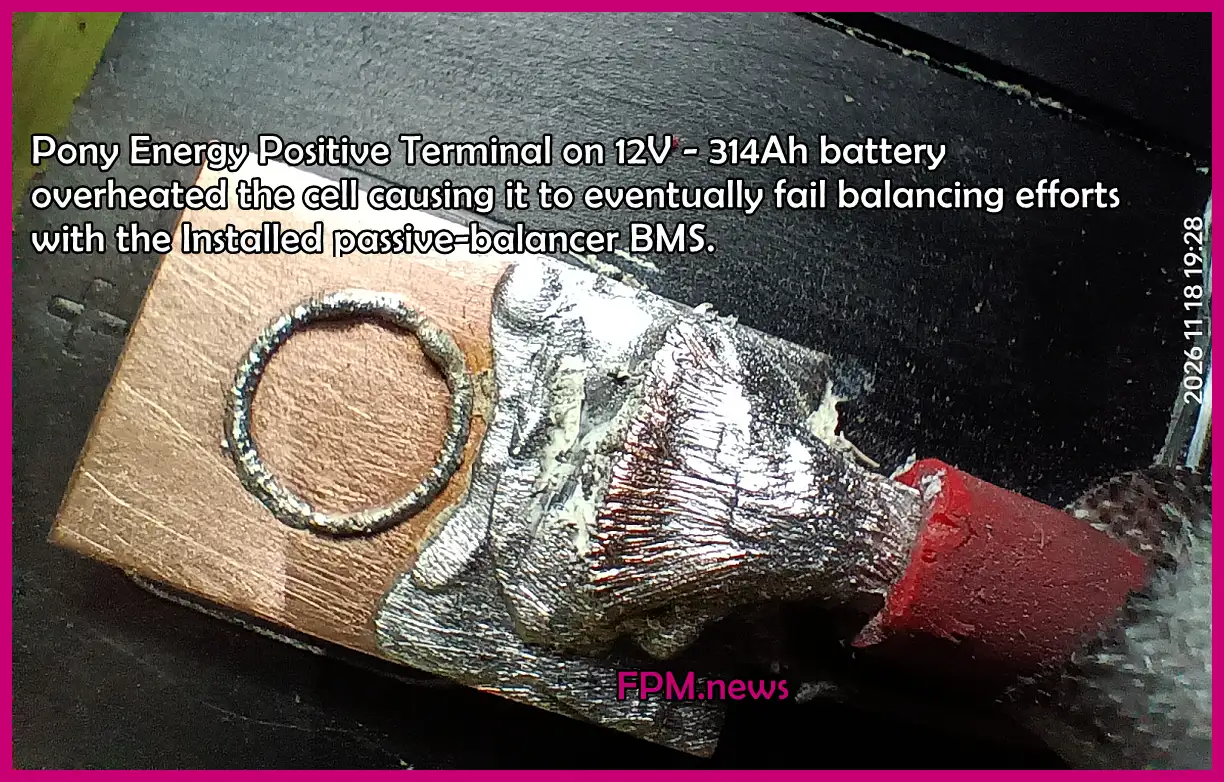
Pony Energy Positive Terminal on 12V – 314Ah battery
overheated the cell causing it to eventually fail balancing efforts
with the Installed passive-balancer BMS. Staff photo. Cropping and resizing by Rosa Yamamoto

Batteries sold in the Philippines tend to be a pay-later scam. The money is still being paid out by the customer for a product that doesn’t get much past unpacking and installing before it locks up. The customer meanwhile is out of time for a refund and is still paying for the battery at Lazada or Shopee. The buyer is out the money they would use to pay for increasing electricity bills.
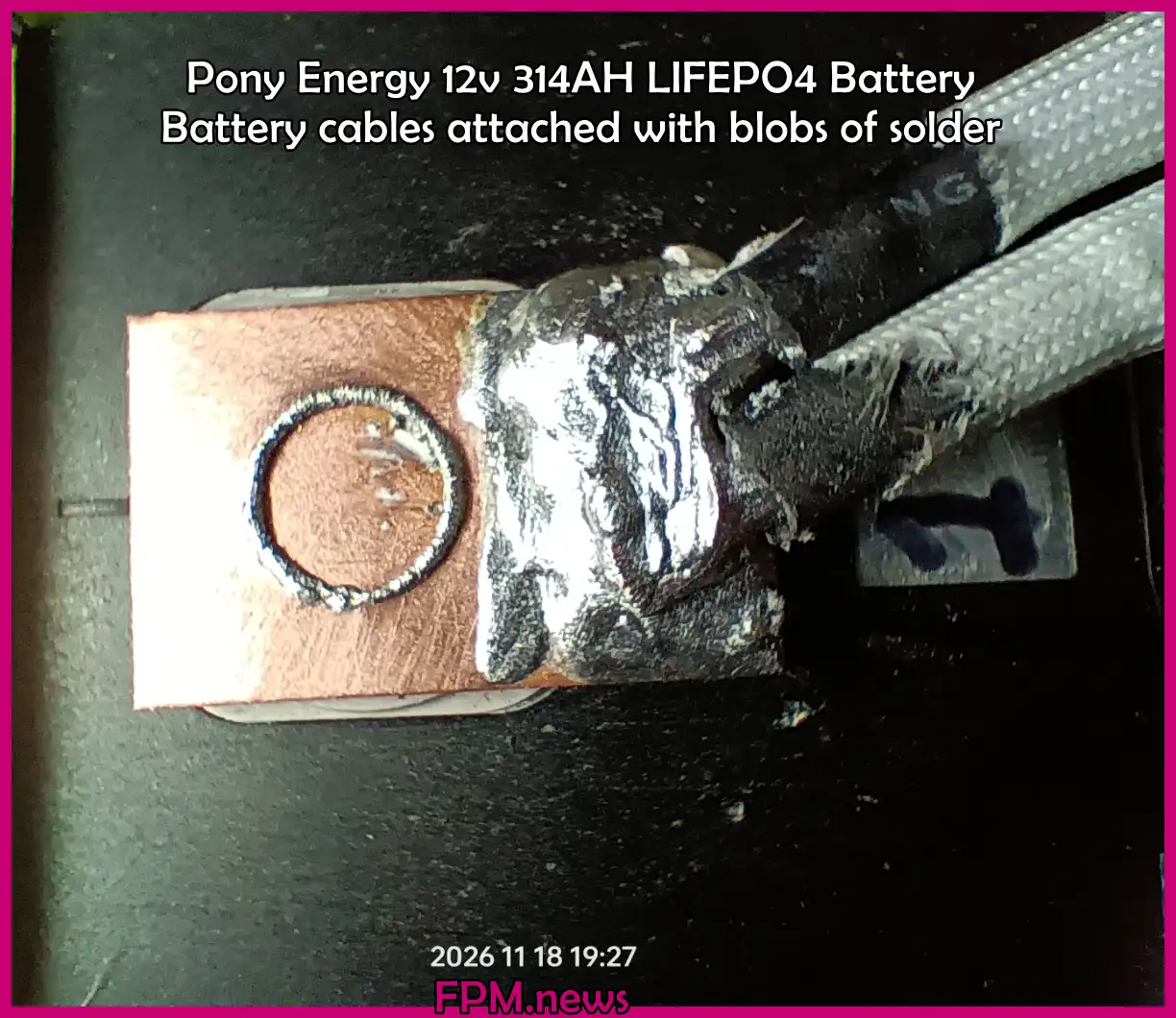
Cleaned of its masking layers of low temp glue from a hot-melt glue gun, this Pony Energy Negative Terminal on 12V – 314Ah battery was soldered in place to the terminal
overheating the cell causing it also to eventually fail balancing efforts with the Installed cheap passive-balancer BMS. Staff photo. Cropping and resizing by Rosa Yamamoto
Do NOT Open the Box Yourself
Some solar hobbyists talk about cutting open these sealed batteries to salvage the cells and install a better BMS. We strongly advise everyday homeowners NOT to do this. A 314Ah lithium battery stores enormous energy. One slip with a metal tool or soldering iron inside the case can cause a blinding electrical arc, severe burns, or fire.
What You Should Do If Your Battery Locks Up
Do Not Force or Cut It Open
Keep the casing sealed and disconnect it from your inverter or charger if it is tripping off (shutting down) early.
Check Your App Data Safely, ask Gemini to explain what you have seen.
Take a screenshot of your Bluetooth battery monitor app (showing the four individual cell voltages) and ask Gemini to help check whether your pack is safe to keep using or showing signs of severe cell imbalance and potential danger.
Demand a Refund Before the Clock Runs Out
Do not let sellers stall you past the 7-day Lazada or Shopee return window with endless messages.File your return claim ASAP after learning the battery is not to your satisfaction. (i.e.: It locks up on the first day of charging.)
If a seller refuses a valid refund for a defective battery, file a formal complaint with the Department of Trade and Industry (DTI) in Manila, including your app screenshots and order receipts.
What Comes Next in This Series
Part 3 — Safety Triage at Home
A visual and video guide showing the immediate warning signs of an overheating lithium pack, which units should never be opened or repaired, and how to isolate a suspect battery safely away from your family.
Part 4 — Fighting the Pay-Later Trap
Step-by-step instructions on how buyers can document defective units, invoke Republic Act No. 11967 (the Internet Transactions Act) and DTI E-Commerce rules to demand refunds, and file fire-hazard reports locally.
Part 5 — Right-Sized Power That Actually Works
How much power a household truly needs for a night light, fan, and phone/tablet—and how women’s community networks are verifying safe, honest alternatives.
Recent similar articles at Babaeako.org
Pages
- Crisis & Disaster Readiness
- Articles
- How Women Can Turn Street Anger into Fiscal Accountability: Women Arm with AI
- Women Arm with AI
- Inside the Philippines LIFEPO battery boxes: Conclusions.
- Humsienk Tests: Inside the Box #2 also denies escape from expensive PH electricity
- Danger inside a battery box breaks the promise of escape from punishing electric bills
- Who Gets the Megawatts? While Manila Courts U.S. AI Data Centers, Philippines Families Are Trapped Between High Electricity Bills and Predatory Solar Scams
- Europe is at war with Russia—reality nobody likes to discuss
- Welcome to Babaeako


