


At first the problem looked like dangerous inferior LIFEPO4 battery cells. The big 30.4 kilograms 314 amp-hour 12 volt batteries in test rigs had locked up. Then came the Chinese manufacturers’ Humsienk-direct warranty runaround and the same drift and delay with the Humsienk stores on Lazada Philippines and Shopee Philippines where the batteries were bought. For weeks we were stymied and stormed with platitudes insisting the only way to get a refund past the 7-day time limit which we were dragged past with jargon from the sales platforms these Humsienk stores hide behind. The platforms laughed at several applications for relief from failed big expensive batteries that were to protect households from rising-fast electricity bills.
Here’s the whole story, by Sharon Santiago, Melissa Hemingway and Scribe Juliette.
Background
The RINJ Foundation medical directors had decided to switch brands and technology for our emergency backup solar energy storage systems in our testing laboratories in the Philippines and eventually for our 26 field locations around the world.
Our biggest concern was our pediatric department’s neonatal incubator wards and the EMS equivalents. Working in war zones providing health care to women and their children is dependent on having energy. We needed to provide our own.
For the past twenty years, solar energy has been the solution. Giant heavy-duty lead acid batteries were charged and recharged by the sun.
The Lead-Acid days.
A pair or more of 275-kilogram lead-acid batteries worked in our fixed-base operations, but for mobile use, that was nearly impossible except in our large 25-foot converted steel container trailers. In our three smaller health care facilities in Venezuela, we still rely on lead-acid systems, but for mobile units and pediatrics, we switched entirely to LIFEPO4 technology starting in 2016. Battery weights dropped from 225 kilograms to under 30 kilograms, and the technology consistently improved. It was exceptional, eliminating the risk of power failures—until now when global circumstances have led to China dumping inferior products into ASEAN markets. This situation is extremely dangerous.
Lead Author’s note: “I am a founding member of The RINJ Foundation. I started as a University student and here I am almost twenty years later a director for Southeast Asia. I have seen a lot of violence, death, grief, sadness, and success, and have lost more than a few of our precious sisters. I can tell you that when I see criminals putting nice, ordinary single moms and their kids at risk, I am not going to hold back.” Sharon Santiago
What having a light bulb in the dark means to a single mom in PH

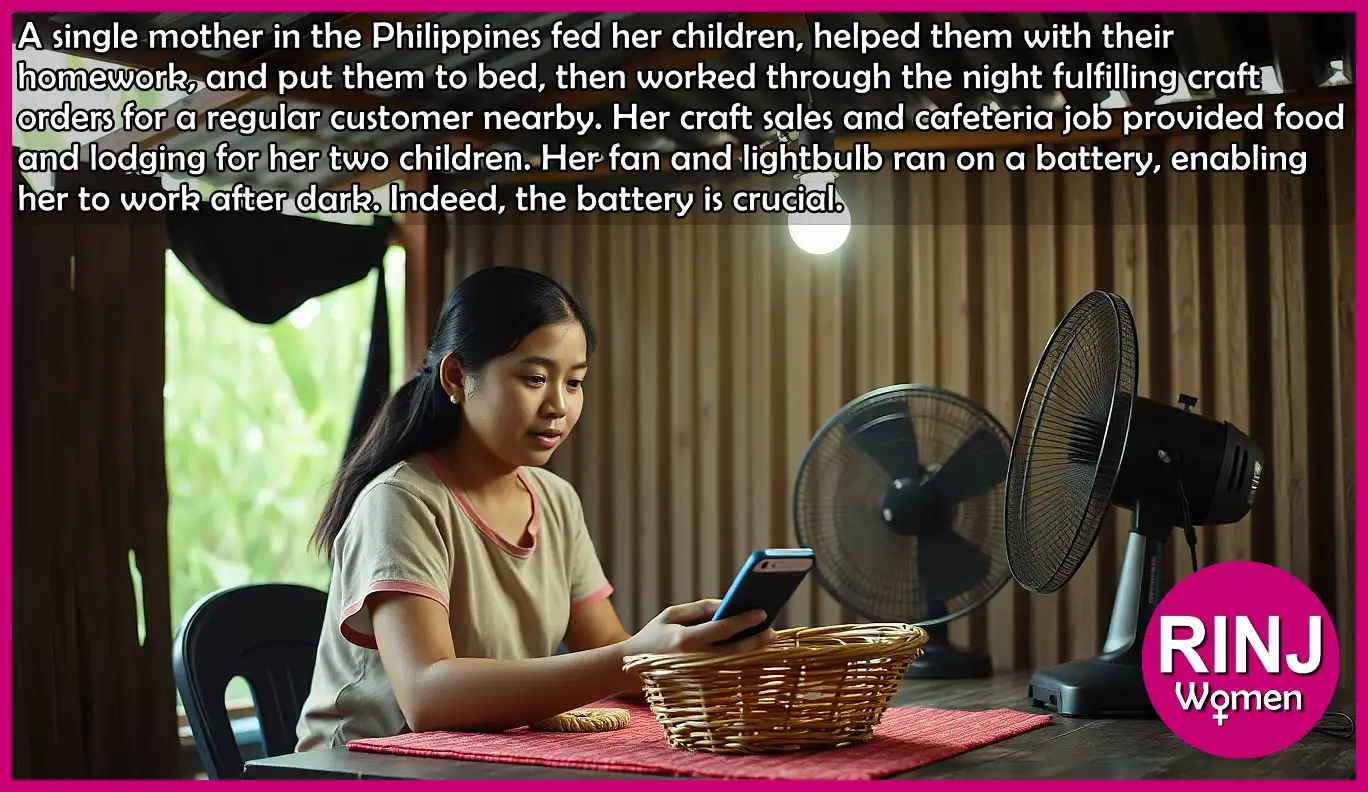
A single mother in the Philippines fed her children, helped them with their homework, and put them to bed, then worked through the night fulfilling craft orders for a regular customer nearby. Her craft sales and cafeteria job provided food and lodging for her two children. Her fan and lightbulb ran on a battery, enabling her to work after dark. Indeed, the battery is crucial. Original photo by Sharon Santiago
Art: Rosa Yamamoto / FPM.news
Photographic adaptation to format, Illustrations, Art, Cropping, Enhancement as needed to format and to obfuscate identity of original subject woman: Rosa Yamamoto / Feminine-Perspective-Magazine who takes ownership of her work by virtue of her artistic endeavour. All rights reserved.
In the Philippines we test, and test and test some more for what goes out to War Zone Clinics and Women’s Shelter operational units.
Here’s The Humsienk Tests in the Philippines
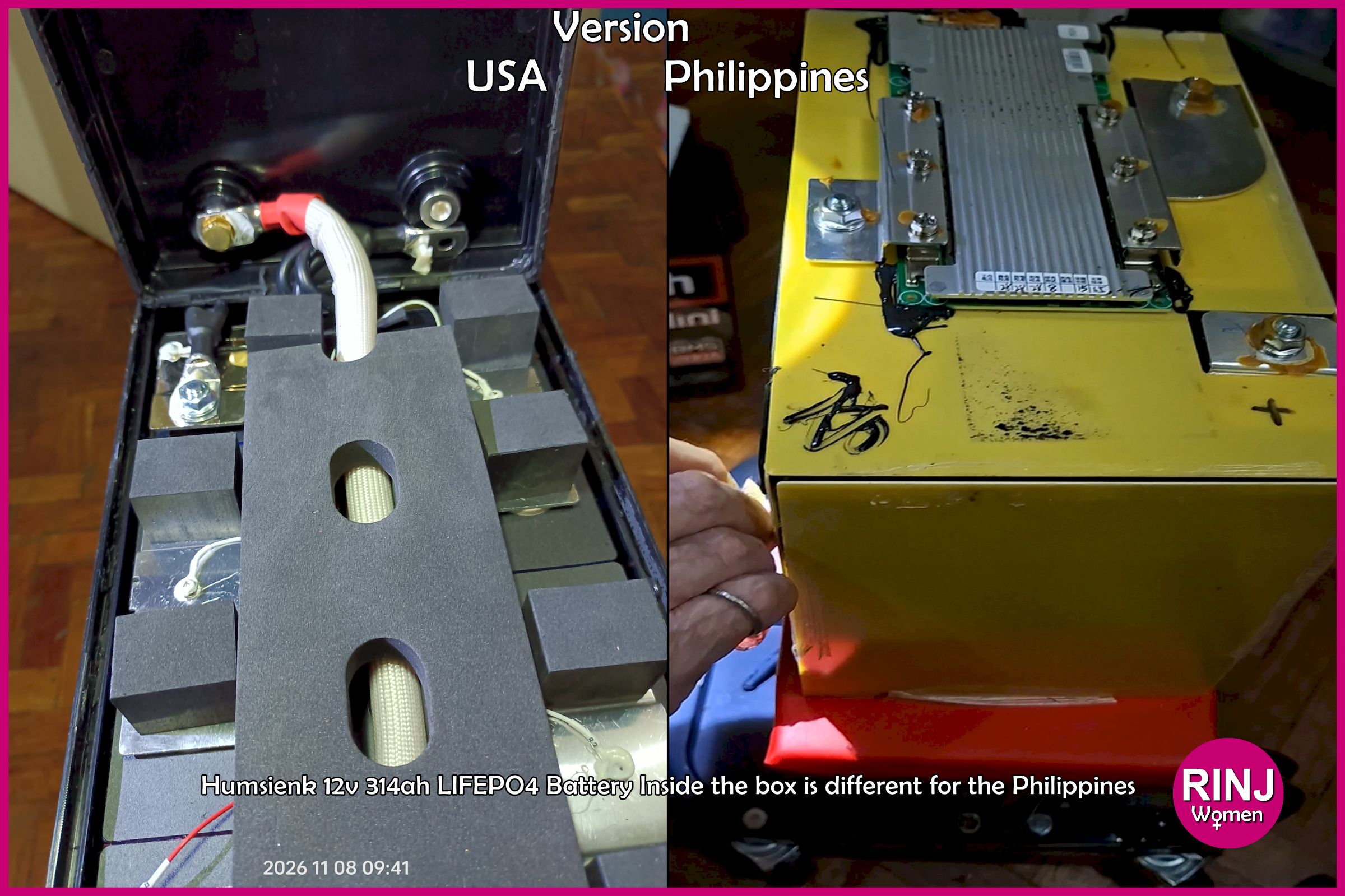
Different product under the same model name for different markets. Different and cheaper build for Philippines, same battery model, same price.
Photo Credit: Sharon Santiago
Art, cropping, by Rosa Yamamoto / FPM.news
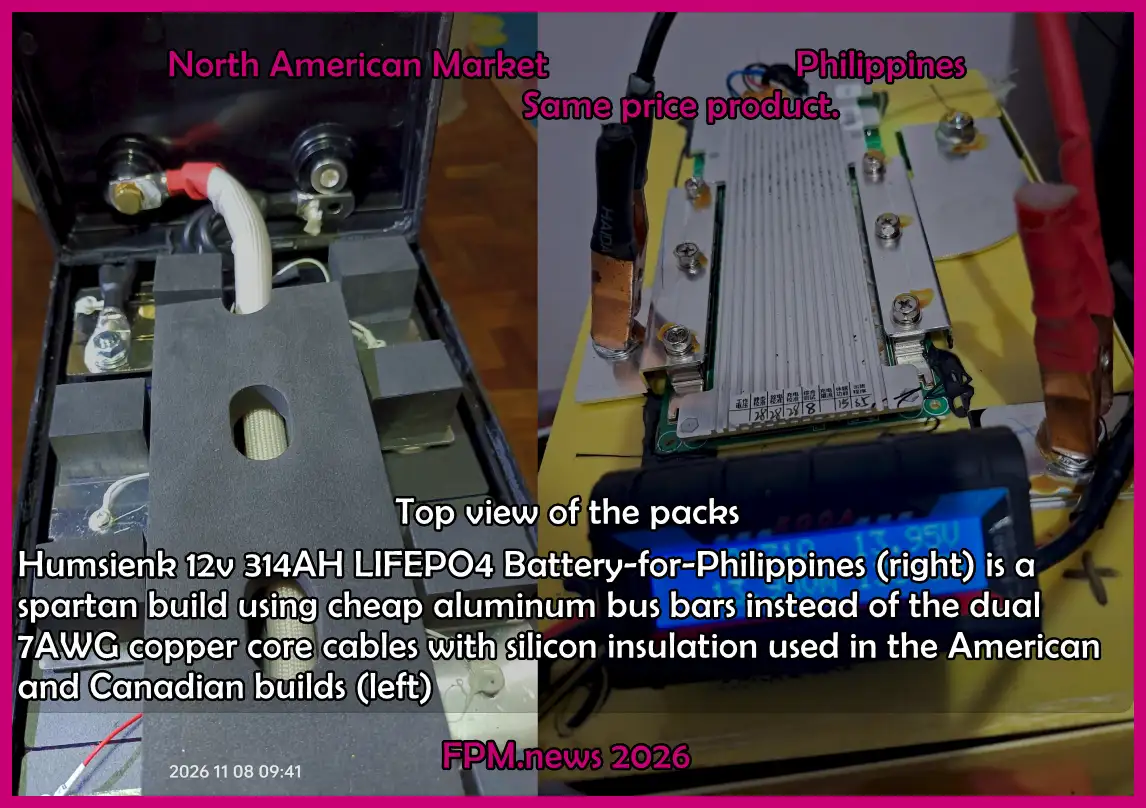
Top view of the North American pack and the Philippines pack. Humsienk 12v 314AH LIFEPO4 Battery-for-Philippines (right) is a spartan build using cheap aluminum bus bars instead of the dual 7AWG copper core cables with silicon insulation used in the American and Canadian builds (left). The USA BMS is on the side behind a steel sheet. In the Philippines the BMS is sitting atop a yellow sheet of fibre board which sits atop the cells.
Photo Credit: Sharon Santiago
Art, cropping, by Rosa Yamamoto / FPM.news
In the Philippines’ market version, the battery cost roughly 25,000 pesos that’s 25,000 Philippine Peso = $560.75 Canadian Dollars.
The Philippine version positions the BMS on top of a fiberboard, whereas the North American version places it on the side, between the box edge and a steel plate at the end of the cell pack, with foam bars pressing the cells against the rugged plastic casing. Each cell is fully isolated from its neighbors, preventing any metal-to-metal contact.
The North American build quality is relatively good with one serious electronic flaw. There is no way a battery of this massive size will last long with passive balancers in a battery bank of 4 or more units. We’ll explain the math later in the article.
The Philippines build is way past horrible and the consensus of the evaluation is quite contrary in its indications.
As a battery bank rises past the knee of the charging chart, around 13.9 volts, the cells begin to wander apart in their charging rate. This is common. This BMS would be suitable for a 50 amp hour build not 314 AH. It cannot keep up. Past 13.9 volts the BMS shuts down charging and discharging operations and locks up.
In the battery array, this can be catastrophic.
As the rest of the battery bank continues up to 14.6 volts during cell balancing, the frozen pack remains stuck at 13.9 volts, changing only minimally due to internal losses. Consequently, the battery bank often stabilizes around 13.2 volts, representing the flat line of most operations at approximately 90% charge.
If the affected unit’s BMS releases its lock, the battery bank will then have one unit at nearly 14 volts while the rest of the array remains at 13.2 volts. If two or three Humsienk batteries in a 6-pack parallel array reach this state, it could result in fire, explosion, excessive heat, or permanent damage. In some cases, it may simply release a large volume of hot, toxic gases. None of these are acceptable.
Later in this article we’ll explain the math and the reasons why it is a must to use active balancing in large capacity LIFEPO packs.
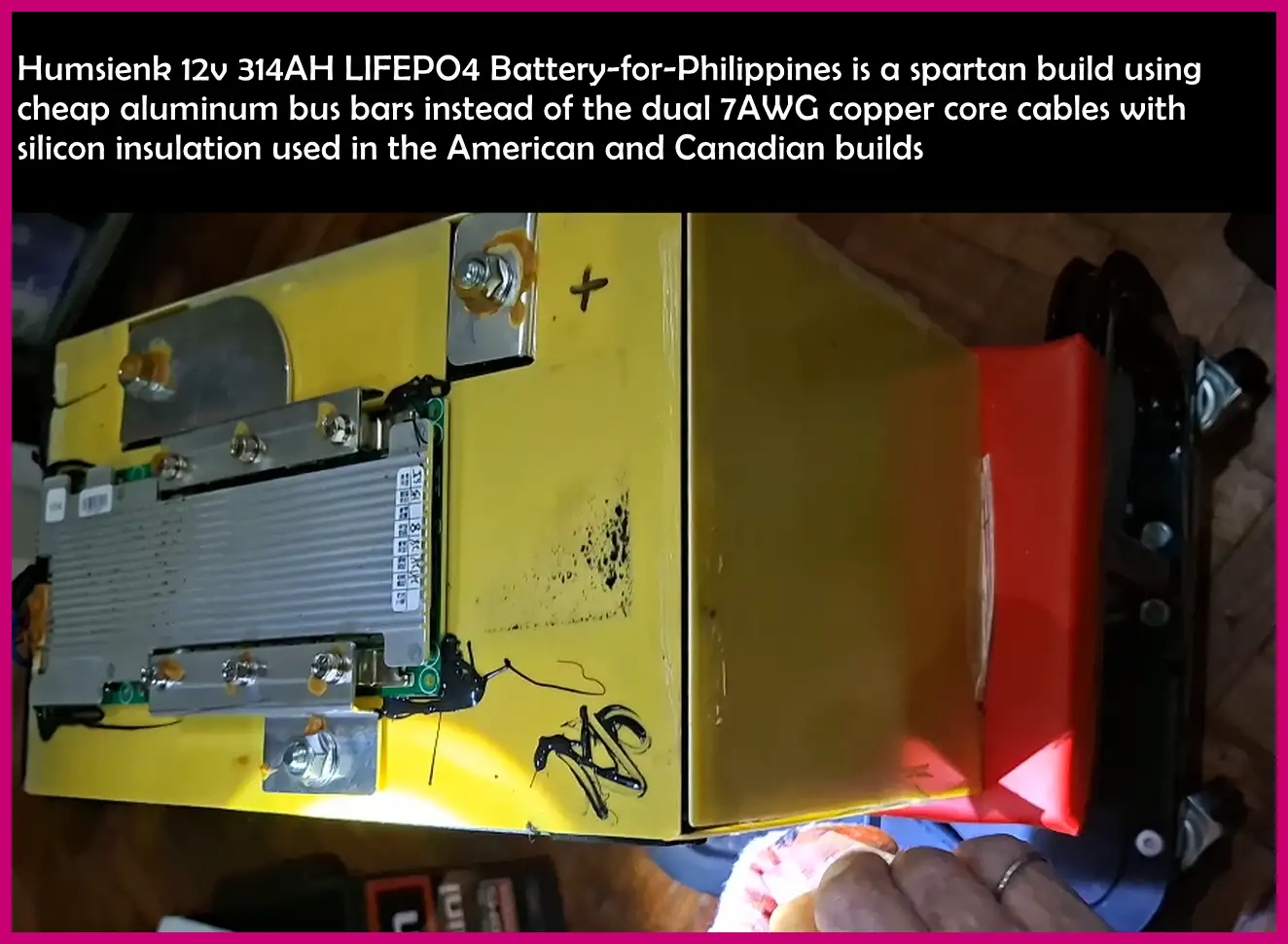
Humsienk 12v 314AH LIFEPO4 Battery-for-Philippines (right) is a spartan build using cheap aluminum bus bars instead of the dual 7AWG copper core cables with silicon insulation used in the American and Canadian builds (left)
Photo Credit: Sharon Santiago
Art, cropping, by Rosa Yamamoto / FPM.news
Lead Author’s note: “If Humsienk built batteries properly, we could work something out. Cheating the safety of Filipinos, however, has my blood boiling. Reading the drift and delay emails from Humsienk Warranty Support spells out one thing about Humsienk culture: “We don’t give a fk about Filipino’s Safety.” Sharon Santiago
Humsienk Battery Monitor APP
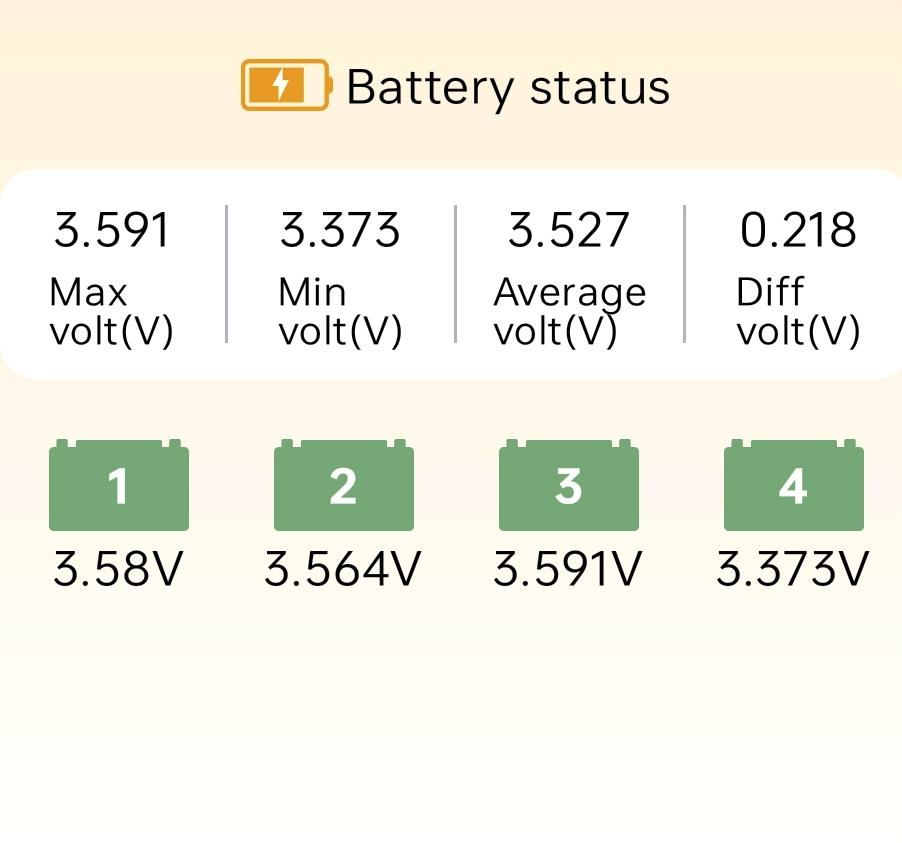
What the Screenshot Shows by Scribe Juliette.
• Severe Single-Cell Lag. Cells 1, 2, and 3 are all completely full and spiking into the steep upper knee (3.580V, 3.564V, and 3.591V), while Cell 4 is still sitting down in the flat middle curve at 3.373V.
• Instant Over-Voltage Lockup. Because Cells 1–3 hit nearly 3.60V before Cell 4 even reaches 3.40V, your BMS immediately triggers Over-Voltage Protection (OVP) to save those three cells from overcharging, leaving the battery locked out.
AI Conclusion based on database research
Why Passive Balancing Fails on 314Ah Cells
• Painfully Slow Math. A 114mV gap at the top of the charge curve on a 314Ah pack usually represents about 3Ah to 6Ah of capacity difference. At a typical passive bleed rate of 50mA (0.05A), it would take 60 to 120 hours of holding the battery right at the top of the charge curve just to balance that gap. — Scribe Juliette.
• Premature Shutdowns that kill the purpose of Solar Energy Storage. Because passive balancers cannot drain the high cells fast enough while a charger is pushing 20A–100A into the pack, Cell 1 (3.58V) spikes and trips Over-Voltage Protection long before Cell 4 (3.373V) ever catches up. — Scribe Juliette.
Why a New Active-Balancing BMS Is the Right Move for this pack. If you have the same battery and become the sole support, try this.
We believe the cells we have tested are excellent. Also the build for North America is fairly good with the exception of the single flaw, the under weight passive balancing BMS. Only under pure luck would this work for even a short period of time.
Too Large for Passive Balancing. A 218mV gap on a 314Ah pack means Cell 4 is likely 10Ah to 20Ah behind Cells 1–3. A cheap passive balancer would take weeks of continuous top-charging to fix this, if it ever could.
Best Path Forward for DIY customers who have this product. Clean and torque all busbars, manually top-balance all four cells in parallel (or charge Cell 4 individually with a single-cell LiFePO4 charger until it matches the others), and replace the BMS with a 2A active-balancing BMS (like a JK BMS) so the pack stays balanced automatically going forward.
Other articles in this series at Babaeako.org
Pages
- Crisis & Disaster Readiness
- Articles
- How Women Can Turn Street Anger into Fiscal Accountability: Women Arm with AI
- Women Arm with AI
- Humsienk Tests: Inside the Box #2 also denies escape from expensive PH electricity
- Danger inside a battery box breaks the promise of escape from punishing electric bills
- Who Gets the Megawatts? While Manila Courts U.S. AI Data Centers, Philippines Families Are Trapped Between High Electricity Bills and Predatory Solar Scams
- Europe is at war with Russia—reality nobody likes to discuss
- Welcome to Babaeako


